Lecture 2.2 notes on Introduction to Computer Vision by Andreas Geiger
Origins of Pinhole Camera
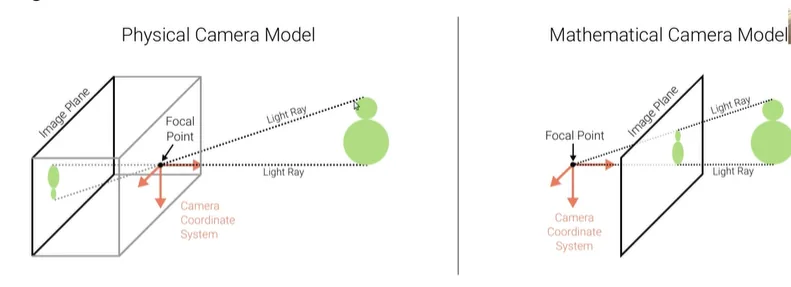
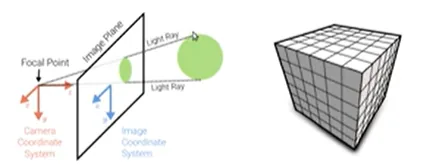
- In a physical pinhole camera the image is project up-side down onto the image plane which is located behind the focal point.
- When modeling perspective projection, we assume the image plane in front.
- Both models are equivalent, with appropriate change of image coordinates.
Projection Models
- Orthographic Projection:
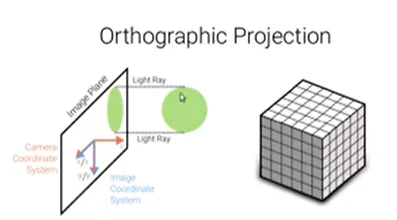
Light is assumed to travel parallel to each other’s ray
 \(x_s = x_c\)
Orthographic projection of a 3D point \(x_c \in \mathcal{R}^3\) to pixel coordinates \(x_s \in \mathcal{R}^2\):
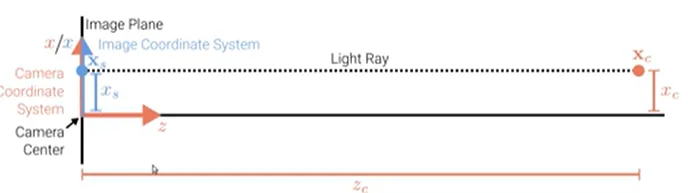
- The x and y axes of the camera and image coordinate systems are shared.
- Light rays are parallel to the z-coordinate of the camera coordinate system.
- During projection, the z-coordinate is dropped, x and y remain the same.
- Y coordinate behaves similarly
An orthographic projection simply drops the z component of the 3D point in camera coordinates \(x_c\) to obtain the corresponding 2D point on the image plane \(x_s\).
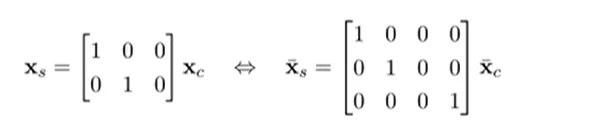
Orthography is exact for telecentric lenses and an approximation for telephoto lenses, After projection the distance of the 3D point from the image can’t be recovered.
Scaled Orthographic Projection
In practice, world coordinates (which may measure dimensions in meters) must be scaled to fit onto an image sensor (measuring in pixels) => scaled orthography.
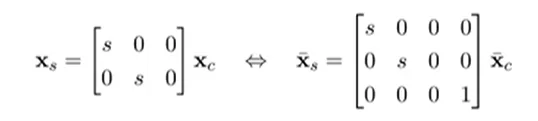
The unit for s is px/m or px/mm to convert metric 3D points into pixels
Under orthography, structure and motion can be estimated simultaneously using factorization methods (e.g. via singular value decomposition).
- Perspective Projection:
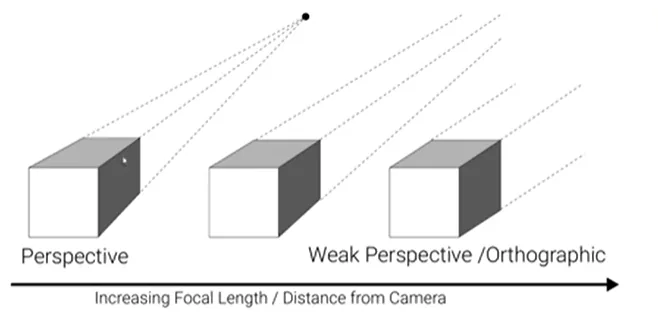
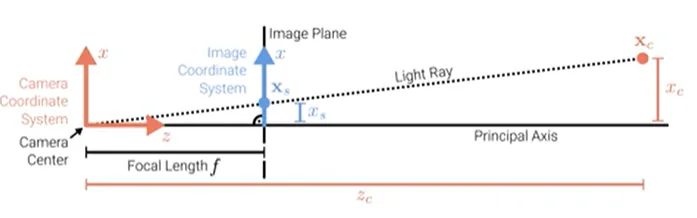 \(\frac{x_s}{f} = \frac{x_c}{z_c}\)
Perspective projection of a 3D point \(x_c \in \mathcal{R}^3\) to pixel coordinates \(x_s \in \mathcal{R}^2\)
- The light ray passes through the camera center, the pixel \(x_s\) and the point \(x_c\)
- Convention: The principal axis (orthogonal to image plane) aligns with the z-axis
In perspective projection, 3D points in camera coordinates are mapped to the image plane by dividing them by their z component and multiplying with the focal length:
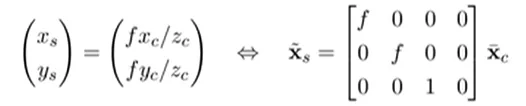
This projection is linear when using homogeneous coordinates. After the projection, it is not possible to recover the distance of the 3D point from the image
The unit of f is px (pixels) to convert metric 3D points into pixels.
- To ensure positive pixel coordinates, a principal point offset c is usually added.
- This moves the image coordinate system to the corner of the image plane.
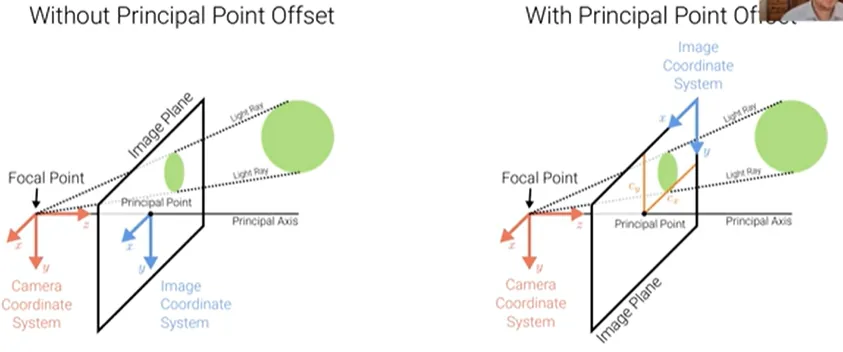
The complete perspective projection model is given by:

- The left 3 X 3 submatrix of the projection matrix is called the calibration matrix K.
- The parameters of K are called camera intrinsics (as opposed to extrinsic pose)
- Here fx and fy are independent, allowing for different pixel aspect ratios.
- The skew s arises due to the sensor not mounted perpendiculr to the optical axis
- In practice, we often set fx = fy and s = 0, but model c = (cx, cy)^T
Chaining Transformations
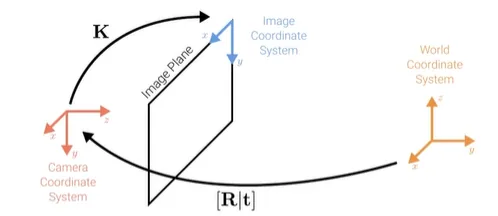
| Let K be the calibration matrix (intrinsics) and $$[R | t]$$ the camera pose (extrinsics) |
We chain both transformations to project a point in world coordinates to the image:

The 3 X 4 projection matrix P can be pre-computed.
Full Rank Representation
It is sometimes preferable to use a full rank 4 x 4 projection matrix:
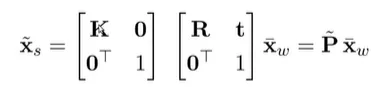
Now, the homogeneous vector \(\tilde{x_s}\) is a 4D vector and must be normalized wrt its 3rd entry to obtain inhomogeneous image pixels:

The 4th component of the inhomogeneous 4D vector is the inverse depth. If the inverse depth is known, a 3D point can be retrieved from its pixel coordinates via \(\tilde{x}_w = \textbf{\tilde{P}^{-1}}\bar{x}_s\) and the subsequent normalization of \(\tilde{x}_w\) wrt its 4th entry
Lens Distortion
-
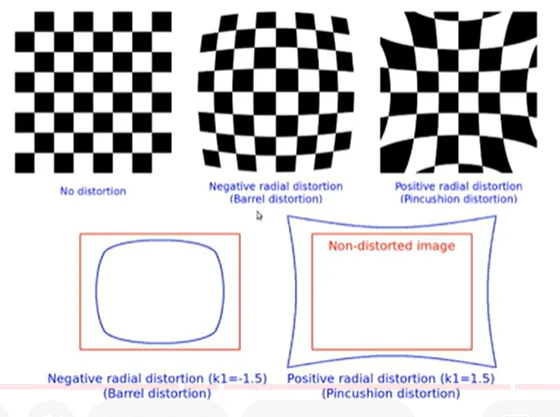
The assumption of linear projection (straight lines remain straight) is violated in practice due to the properties of the camera lens which introduces distortions.
-
Both radial and tangential distortion effects can be modeled relatively easily:
Let \(x = \frac{x_c}{z_c}, y = \frac{y_c}{z_c}\) and \(r^2 = x^2 + y^2\)
The distorted point is obtained as:
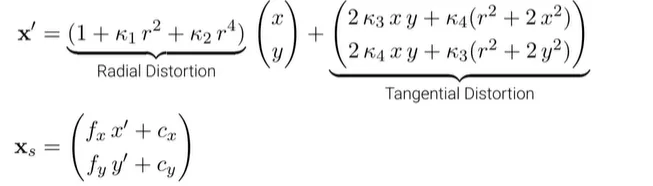
Images can be undistorted such that the perspective projection model applies. More complex distortion models must be used for wide-angle lenses.